
Published
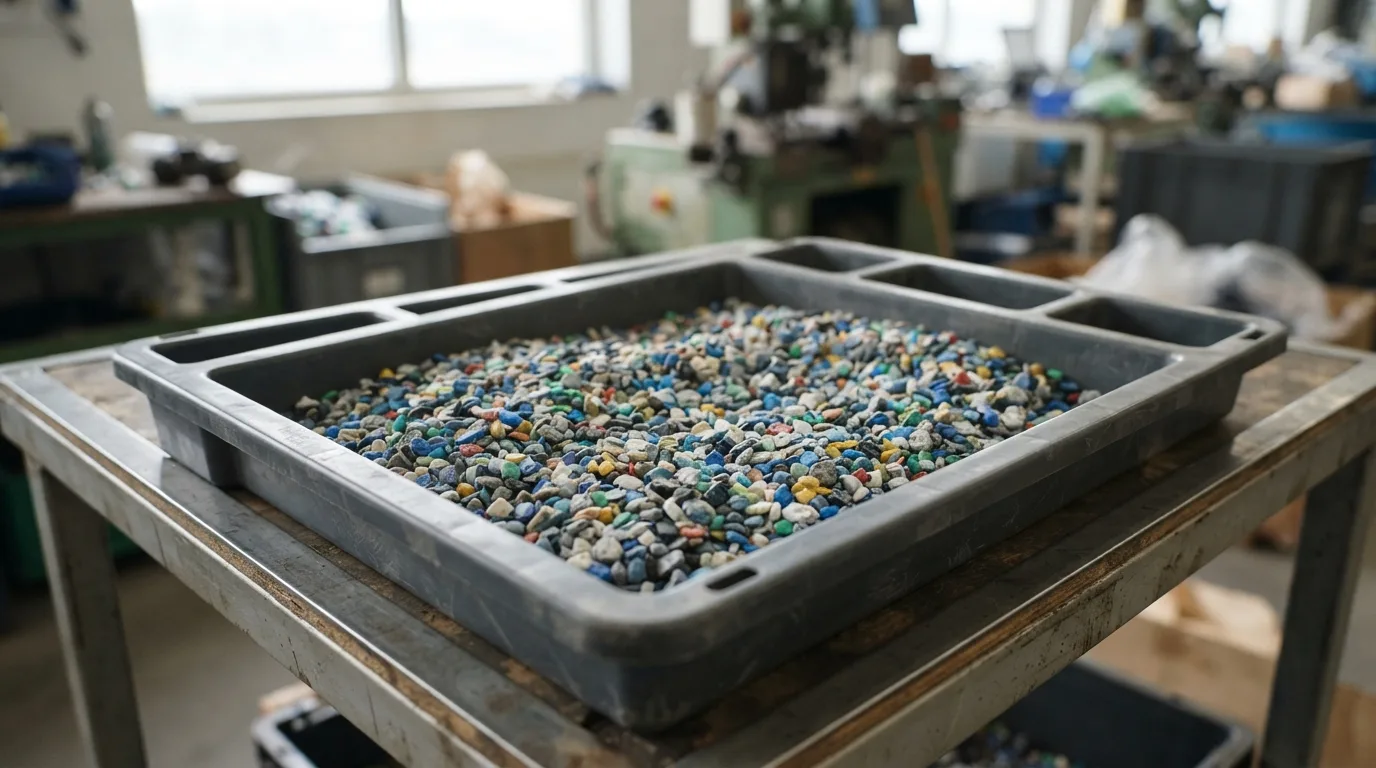 Recycled plastic dana pellets displayed in an industrial inspection tray
In industrial manufacturing, plastic dana refers to reprocessed polymer pellets produced by shredding, washing, melting, and compounding scrap into uniform beads. Factory conversion machinery requires this standardized pellet form rather than raw regrind flakes to prevent feed throat bridging, stabilise melt pressure, and maintain uniform shot weights.
What Is Plastic Dana and What Is It Called in English?
In international trade and polymer engineering, plastic dana is called recycled plastic granules, polymer pellets, or reprocessed plastic chips typically sized between 2.5 mm and 4.0 mm. Regional markets use the trade word dana to describe the granular form of the material, while standard industrial datasheets classify these products under their base chemical families, such as recycled polypropylene or recycled polyethylene.
A clear physical distinction separates raw scrap flakes from compounded pellets. Scrap flakes, known in processing workshops as regrind or kachra, consist of un-melted scrap items chopped by granulator blades into jagged, flat fragments. These un-melted flakes vary widely in bulk volume, trap air pockets, and retain abrasive surface dirt. In contrast, pelletized granules pass through an extruder barrel, undergo continuous melt filtration, and emerge chopped into uniform geometric cylinders or spheres.
This geometry sets a predictable bulk density that stabilizes feeding dynamics inside factory machinery. Raw flakes bridge across hopper throats, starving the screw and causing barrel pressure to swing wildly. When converters switch a moulding line from raw regrind to compounded pellets, the processing changes immediately:
- Feed throat cooling can be dialed back to normal operating levels because pellets do not pack and fuse prematurely under hopper weight.
- Screw backpressure can be reduced by 15 bar to 25 bar because pellets do not require high mechanical compaction to drive out trapped air.
- Screw recovery times drop and stay consistent within tenths of a second, eliminating shot-weight drift and part shorting without raising injection speeds.
How Compounded Pellets Are Made: Extrusion and Pelletizing Stages
Reprocessed pellets are manufactured through scrap sorting, friction washing, continuous thermal extrusion, fine melt filtration, and underwater or strand pelletizing.
```
[Raw Scrap] ➔ [Sorting & Shredding] ➔ [Friction Wash & Dry] ➔ [Melt Extrusion] ➔ [Screen Filtration (80-120 Mesh)] ➔ [Pelletizing] ➔ [Sieving & Packaging]
```
Feedstock preparation determines base purity. Technicians sort incoming scrap by polymer type and base color. Heavy granulators shred rigid moldings or baled film into flakes. These flakes pass into high-speed friction washers and float-sink tanks. Water baths separate heavy dirt, grit, and non-polyolefin plastics by specific gravity, while wash stages strip residual adhesives, inks, and surface greases. Centrifugal dryers then spin off surface moisture before the clean flakes enter the extruder hopper.
Thermal compounding takes place inside extruders equipped with vented vacuum degassing zones. As the polymer melts along the heated barrel, volatile compounds, moisture traces, and trapped processing gases escape through vacuum ports under negative pressure.
Continuous melt filtration captures foreign solids. The molten plastic stream passes through hydraulic twin-piston screen changers fitted with woven wire gauze screens ranging from 80 mesh to 120 mesh. These steel wire meshes catch unmolten polymer fragments, wood splinters, metal traces, and high-temperature foreign polymers before the melt reaches the die head.
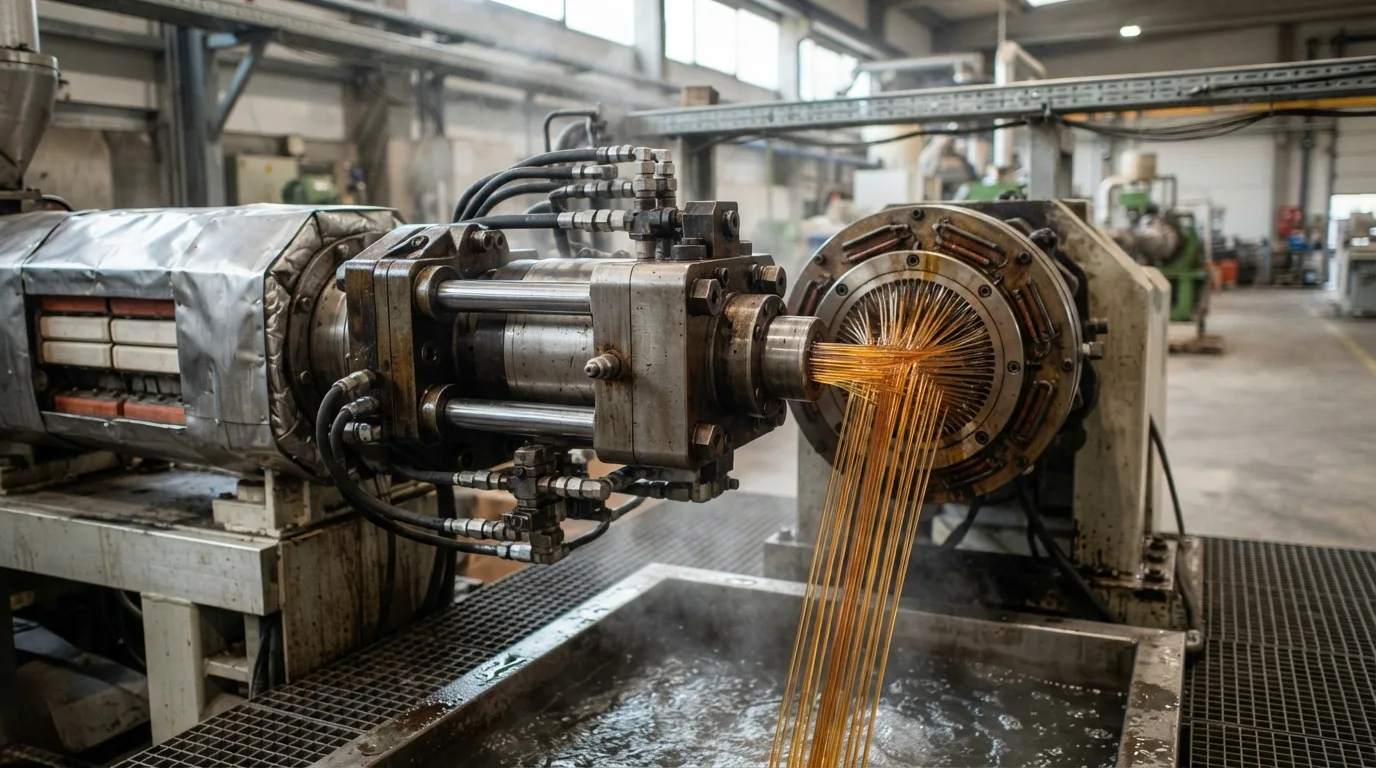 Twin-piston screen changer and strand die face on an industrial recycling extrusion line
Two pelletizing methods turn the filtered melt into solid granules:
* Strand pelletizing pushes continuous molten strands through a multi-hole die plate into a circulating water cooling bath. Once solid, rotary knives cut the dry strands into cylindrical pellets.
* Die-face pelletizing cuts the molten polymer immediately at the die surface with rotating blades, cooling the beads instantly with a water ring.
Both cutting systems require sharp blades and precise water temperature control to eliminate hollow tails, fine dust, and oversized doubles that cause pneumatic transfer line clogs.
Commercial Grades: Post-Industrial vs Post-Consumer Feedstock
Commercial reprocessed resins are grouped into post-industrial resin (PIR) and post-consumer resin (PCR) based on scrap origin, contamination risk, and color consistency.
PIR material originates from clean factory scrap, such as unprinted trim, start-up purgings, injection runner sprues, and reject parts collected directly from manufacturing floors. Because these scrap sources have traceable processing history and zero outdoor exposure, PIR granules offer high batch uniformity. Converters achieve a tight melt flow index tolerance within ±1.0 g/10 min. PIR is readily available in natural, translucent, or milky white grades that take color masterbatch at low let-down ratios.
PCR material comes from municipal collection streams, including discarded milk jugs, detergent containers, grocery sacks, and agricultural mulch film. PCR feedstocks endure sun exposure, polymer oxidation, and contamination from paper labels and chemical residues. Processing PCR requires multi-vent vacuum degasification to purge trapped odors. Because municipal streams mix many colored packages together, PCR pellets are compounded into dark gray, olive, or solid black pellets, fitting utility drainage pipes, conduit, heavy bins, and transport pallets.
| Grade Parameter | Post-Industrial (PIR) | Post-Consumer (PCR) |
|---|---|---|
| Feedstock Origin | Factory edge trims, blow trim, moulding rejects | Municipal discarded packaging, retail scrap |
| Contamination Risk | Low; minimal grit or adhesive residues | Moderate to high; requires 100 to 120 mesh screens |
| Melt Flow Tolerance | Tight (within ±1.0 g/10 min) | Broader (within ±2.5 g/10 min) |
| Typical Density Range | 0.905 to 0.915 g/cm³ (PP), 0.950 to 0.960 g/cm³ (HDPE) | 0.910 to 0.925 g/cm³ (PP), 0.945 to 0.962 g/cm³ (HDPE) |
| Color Range | Natural, translucent, clean bright shades | Dark gray, olive green, deep black |
| Extrusion Melt Temp | 190 °C to 220 °C | 200 °C to 235 °C |
| Common End Uses | Housewares, rigid storage tubs, cosmetic caps | Corrugated conduit, drainage pipes, shipping pallets |
Natural and milky white pellets allow buyers to tint resin to specific target shades using standard color masterbatches. Buying dark gray or black pellets eliminates the cost of coloring additives, but converters must dedicate those materials to structural moldings where color shade consistency across production lots is not critical.
What Are Recycled Granules Used For Across Industrial Lines?
Recycled polymer pellets serve as direct feedstocks for plastic converters operating injection moulding, blow moulding, and profile or film extrusion machinery across several manufacturing sectors.
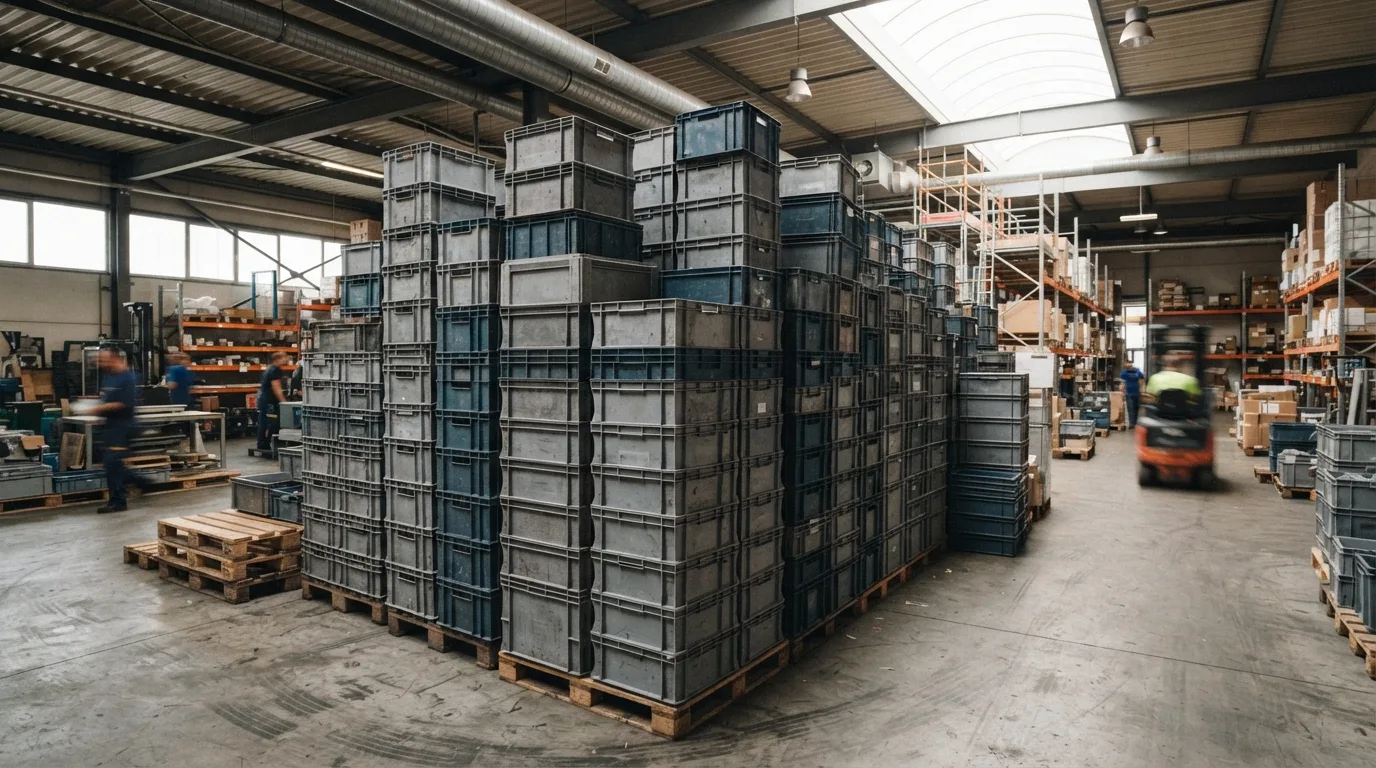 Moulded plastic storage crates stacked in an industrial warehouse
Injection moulding plants require high-fluidity resin to fill multi-cavity tools quickly without requiring extreme injection pressures. Facilities manufacturing transport crates, battery cases, and storage totes run Recycled PP Injection Moulding Grade Granules and Recycled PP Crate / Basket Injection Grade Granules. These lines use pp dana with a melt flow index between 10 g/10 min and 25 g/10 min at 230°C under a 2.16 kg load, keeping cycle times short and preventing part warpage across broad surface areas.
Extrusion blow moulding operations demand high melt strength to prevent parison sag when forming large hollow containers. Plants producing industrial chemical containers, chemical carboys, and lubricant jugs use fractional-melt resins such as Recycled HDPE Blow Moulding Grade — 1–10L. These high-density polyethylene resins feature an MFI between 0.2 g/10 min and 0.8 g/10 min at 190°C/2.16 kg, giving the vertical parison enough stiffness to hold its shape until tool clamp closure.
Continuous profile, tape, and film extrusion lines run lower-melt polypropylene granules and linear low-density polyethylene pellets. Extruders manufacturing woven sacks, strapping bands, and geotextiles run Recycled PP Raffia Blow Grade Granules with an MFI between 2.5 g/10 min and 4.0 g/10 min at 230°C/2.16 kg to achieve high tensile strength without filament snapping. Corrugated conduit lines and heavy construction film extruders consume tough polyethylene grades to resist puncture and split failures under mechanical stress.
Evaluating Granule Quality: Which Shop-Floor Tests Work?
The best quality reprocessed pellets exhibit uniform cut dimensions, stable melt flow rates, low moisture, and an ash content that matches the supplier specification sheet. Factory teams can run four immediate shop-floor quality tests before dumping raw material into machine feed hoppers:
Fines and Dust Sieve Test. Dust and micro-fines melt prematurely on the screw shank, creating dark specks and erratic feeding. Weigh a 1 kg sample from a random production sack. Pour the resin onto a standard 1 mm wire mesh sieve and shake vigorously for two minutes. Weigh the powder that passes through the wire screen. High-grade reprocessed material should contain less than 2 g of fines per 1 kg sample.
Float-Sink Density Verification. To verify that a polyolefin shipment has not been adulterated with heavier engineering scrap or excessive filler, drop fifty sample pellets into a clean transparent cylinder filled with water at 23°C. Virgin and high-grade polyolefins have densities below 1.00 g/cm³ and float on the surface. If pellets sink to the bottom, the lot contains dense contaminants like styrenics, vinyls, or high mineral loads.
Ash and Mineral Filler Verification. Some reprocessed resin contains excess chalk or talc filler, which increases part brittleness and accelerates tool steel wear. Weigh a clean, dried 5 g resin sample into a ceramic crucible. Burn the resin completely under high heat inside a muffle furnace until only white inorganic ash residue remains. For unfilled grades, mineral ash residue must remain below 30 g per 1 kg of resin.
Hot-Plate Moisture Check. Water trapped inside pellets turns into steam inside the heated barrel, causing splay marks, surface silvering, and nozzle drool. Place twenty pellets onto a heated steel hot plate set to 180°C. Press a clean glass microscope slide firmly over the melting pellets. If foaming bubbles, crackling pops, or condensation hazing appear, moisture levels exceed 0.8 g per 1 kg of material. Reject the lot or run the material through a desiccant hopper dryer before moulding.
An open-air barrel purge shot complements these checks. Purging 200 g of melt straight onto clean cardboard lets an operator check viscosity by eye: a continuous, glossy, bubble-free puddle confirms adequate degasification and low moisture.
Specialized compounders like Golden Square Plast maintain controlled extrusion lines to keep pellet geometry, melt flow, and moisture stability within narrow production bands.
Buyer Misconceptions About Recycled Polypropylene Granules
Plant managers and purchasing agents often hold assumptions about reprocessed polyolefins that lead to poor processing results.
A common myth is that black or charcoal pellets are degraded, lower-tier materials. Dark coloration does not automatically mean polymer thermal breakdown. Recyclers often combine clean, unprinted colored off-cuts into a single run and add a standard black pigment concentrate to achieve an even base color. When compounded from un-degraded scrap, black pellets retain high tensile strength and impact resistance equal to lighter shades.
Another mistake is processing reprocessed resin using the identical barrel temperature profile established for prime virgin material. Reprocessed polyolefins carry a prior thermal history and feature lower shear viscosity. Setting virgin barrel profiles overheats reprocessed resin, causing nozzle drool, mold flashing, and thermal degradation. Lower the rear and middle barrel zones by 10°C to 15°C when switching from virgin resin to reprocessed pellets, then adjust back pressures to stabilize screw recovery.
Shop-floor drying errors also ruin good resin. Assuming that every recycled lot tolerates the same drying cycle causes molders to either skip desiccant drying on moisture-sensitive lots or over-bake clean polyolefins in hot-air hoppers, driving oxidative brittleness before the resin enters the feed zone.
Converters also risk plant downtime by buying on open spot markets through visual hand samples. Evaluating a handful of pellets from a single sack tells an engineer nothing about melt flow consistency or batch-to-batch contamination. Secure deliveries based on documented melt flow index ranges, density values, and ash limits. Standardizing your incoming resin requirements protects your injection moulds and keeps your production output predictable.
To review technical polymer specifications or order production-ready samples for your factory, contact Golden Square Plast or Request a quote directly from our engineering team.