
Published
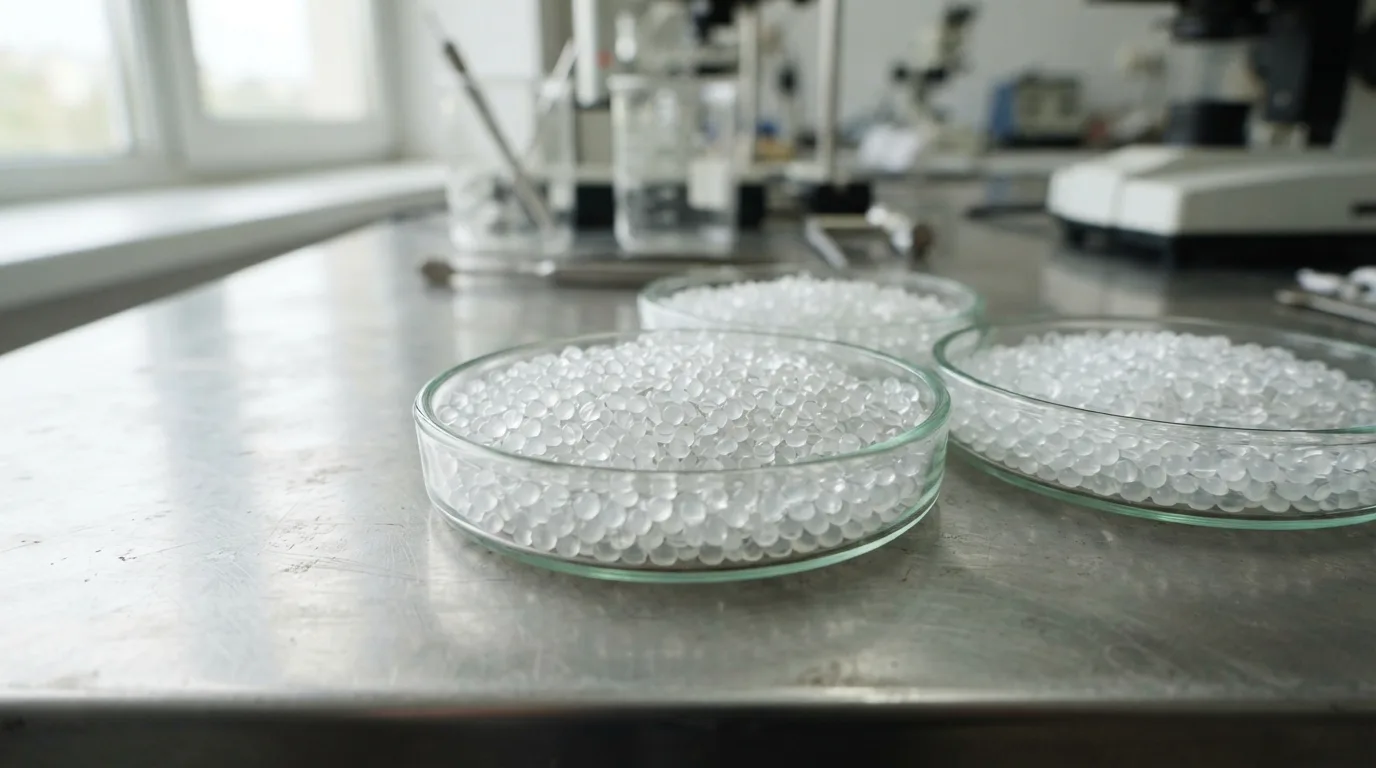 Uniform plastic granules on an inspection surface
Plastic granules are uniform polymer solids, typically measuring 2 to 4 mm, engineered for stable feeding and plastification in conversion equipment. Manufactured through continuous melt extrusion, screen filtration, and strand or die-face cutting, they provide steady bulk density, eliminate feed throat bridging, and guarantee repeatable melt delivery during profile extrusion, blow moulding, and injection cycles.
What Are Plastic Granules and How Do They Relate to Plastic Pellets?
The raw material of plastic consists of polymerized olefin chains synthesized from petrochemical feedstocks such as ethylene and propylene, or reclaimed from re-compounded industrial polymer streams. These synthetic macromolecules undergo compounding to yield solid particles with a standardized cylindrical or lenticular geometry measuring 2 to 4 mm in diameter and length.
Converters rely on this specific geometry to secure a stable bulk density within the range of 0.45 to 0.60 g/cm³. In contrast, raw industrial flakes, regrind chips, and fine synthesis powders exhibit broad particle size distributions and poor flowability, leading to erratic packing in machinery hoppers.
In industrial terminology, the terms plastic pellets, nurdles, and granules designate identical intermediate physical states. Primary synthesizers often refer to reactor output as pellets or nurdles, whereas downstream compounders and re-processors frequently use the term granules. Both terms identify clean, fully compounded polymer masses formulated with process stabilizers and cut to precise dimensions for pneumatic conveyance and hopper loading.
While virgin material arrives directly from polymerization reactors after compounding, recycled grades originate from sorted, washed, and re-extruded manufacturing scrap. Both physical formats fulfill the exact same mechanical requirement: presenting a uniform, free-flowing solid to the machine feed throat.
How Are HDPE and Polyolefin Pellets Manufactured?
To make HDPE and polyolefin pellets, compounding lines melt clean polymer scrap or virgin fluff in an extruder barrel, force the fluid through screen filters, and cut the cooling strands into beads.
The process begins by feeding flakes or fluff into the extruder throat. The barrel utilizes controlled heating zones operating between 180 °C and 240 °C for polyethylene and polypropylene resins. This thermal envelope, combined with mechanical shear from the rotating screw flights, transforms solid polymer into a uniform, degassed melt stream without causing thermal chain scission or molecular degradation.
```
Feed Stock (Flakes/Fluff) ➔ Extruder Barrel (180–240 °C) ➔ Melt Filtration (40–120 Mesh) ➔ Strand / Die-Face Cutter ➔ Classified Pellets
```
Before shaping, the pressurised melt passes through continuous melt filtration systems. These screen changers employ woven wire mesh packs ranging from 40 mesh down to 120 mesh (apertures of 400 microns down to 125 microns). Filtration screens capture unmelted gels, metal specks, mineral dust, and degraded crosslinked residues that would otherwise cause wall thinning in blow-moulded bottles or pinholes in extrusion film.
Once filtered, the clean polymer melt enters the pelletizing stage through one of two mechanical methods:
1. Strand Pelletizing: The extruder forces the melt through a multi-hole die plate to generate continuous strands. These cords pass through a water cooling trough to solidify before high-speed rotary blades chop them into cylindrical pellets.
2. Underwater or Water-Ring Die-Face Cutting: Rotating knives slice the melt immediately as it emerges from the die holes. Water circulating across the die face quenches the cut beads instantly, yielding highly uniform lenticular or spherical shapes with minimal fines.
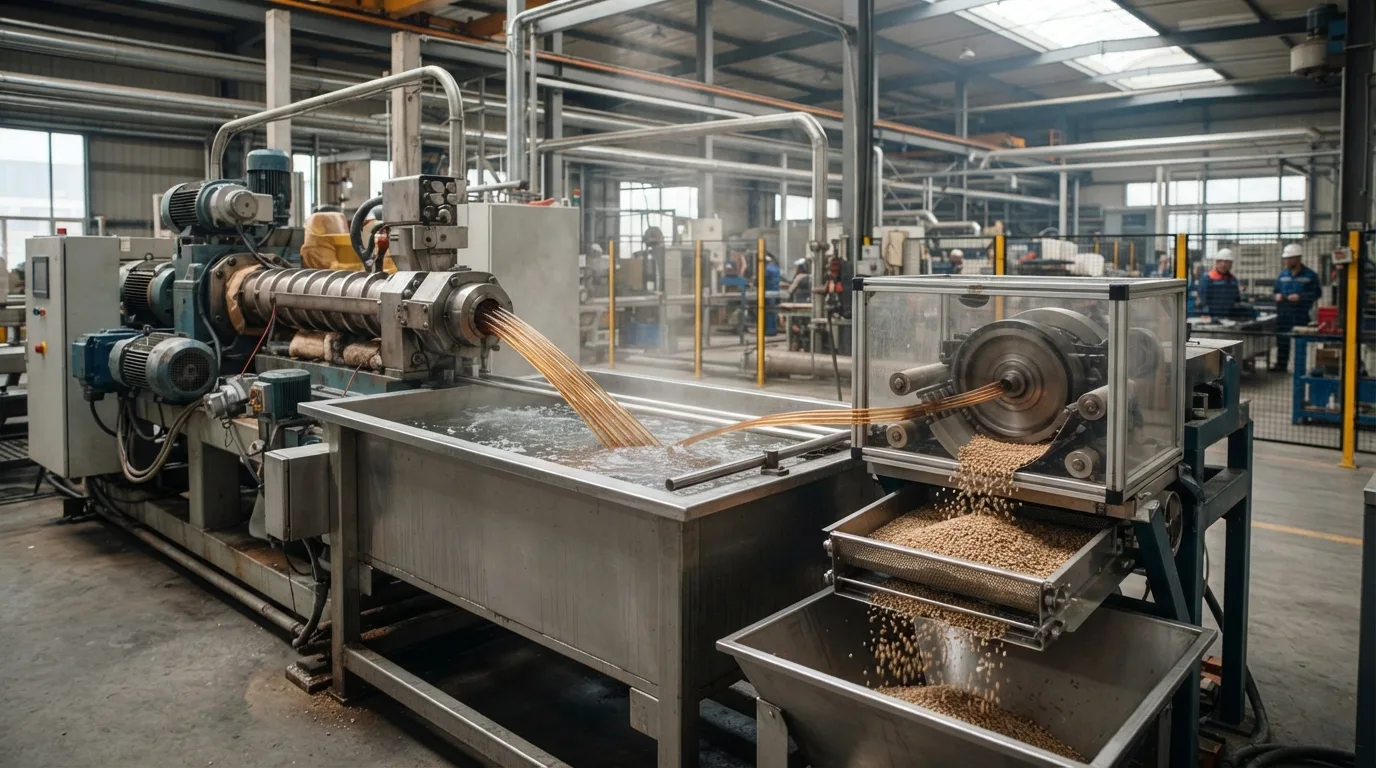 Continuous compounding extrusion and strand cutting line
How Many Types of Extrusion Resins Are Used in Manufacturing?
There are four primary types of polyolefin resins used in manufacturing—polypropylene (PP), high-density polyethylene (HDPE), low-density polyethylene (LDPE), and linear low-density polyethylene (LLDPE)—with polypropylene serving as a rigid polymer suited for demanding thermal conditions. Polypropylene provides high flexural modulus, chemical resistance, and heat deflection resistance above 100 °C, performing reliably in homopolymer forms for thin-wall items and copolymer blends for high-impact structural crates.
Polyethylene grades separate into distinct categories according to molecular branching and density:
- High-Density Polyethylene (HDPE): Spanning densities from 0.941 to 0.965 g/cm³, HDPE possesses a linear molecular chain with minimal branching, providing high tensile strength and rigidity for blow-moulded drums, chemical containers, and pressure pipe systems.
- Low-Density Polyethylene (LDPE): Ranging from 0.910 to 0.925 g/cm³, LDPE contains long-chain branching that prevents close molecular packing, resulting in high flexibility and clarity for general packaging liners.
- Linear Low-Density Polyethylene (LLDPE): Ranging between 0.918 and 0.935 g/cm³, LLDPE features short, uniform branches that impart higher puncture resistance and tensile yield compared to standard LDPE.
Each grade is further classified by its melt flow index (MFI), which indicates molecular weight and viscosity under shear. Fractional melt resins (below 1.0 g/10 min at 190 °C under a 2.16 kg load) offer high melt strength for large blow moulding, while injection moulding demands fluid resins ranging from 8.0 g/10 min to over 25.0 g/10 min (at 230 °C under 2.16 kg for PP) to pack intricate tool cavities rapidly.
Polyolefin Granule Matrix
| Polymer Family | Density (g/cm³) | Standard MFI Ranges (g/10 min) | Melting Temperature (°C) | Typical Machine Barrel Settings (°C) |
|---|---|---|---|---|
| Polypropylene (PP) | 0.900–0.915 | 1.5 to 35.0 (230 °C / 2.16 kg) | 160–168 | 200–250 |
| High-Density Polyethylene (HDPE) | 0.941–0.965 | 0.05 to 12.0 (190 °C / 2.16 kg) | 130–135 | 180–230 |
| Low-Density Polyethylene (LDPE) | 0.910–0.925 | 0.3 to 8.0 (190 °C / 2.16 kg) | 105–115 | 160–210 |
| Linear Low-Density Polyethylene (LLDPE) | 0.918–0.935 | 0.8 to 20.0 (190 °C / 2.16 kg) | 120–128 | 170–220 |
Converters sourcing polyolefins can review technical data for specific grades through the Products inventory, or explore dedicated resin selections via the Recycled PP Granules Supplier in the UAE catalogue, the Recycled HDPE Granules Supplier in the UAE section, and the Recycled LDPE / LLDPE Granules Supplier in the UAE technical listings.
What Are Granular Resins Used for in Machine Feeding and Conversion?
Polymer granules are used to feed continuous conversion machinery, supplying consistent melt for blown film extrusion, hollow container blow moulding, and injection moulding of rigid components. In downstream manufacturing, film blowing lines convert these resins into agricultural films and flexible packaging, extrusion blow moulding machines shape them into bottles and jerrycans, and injection units form items ranging from industrial transport crates to thin-wall closures.
Feeding performance governs the quality of these final conversions. Gravimetric loss-in-weight feeders and volumetric dosing augers require regular, spherical or short-cylindrical geometry to meter raw polymer accurately into the machine throat.
When operators attempt to feed loose flake or irregularly ground regrind, material bridges over the throat opening or forms empty funnels known as rat-holes. This interruption starves the screw flights, causing immediate feed surging, melt temperature instability, and dimensional variance in extruded profiles or moulded parts.
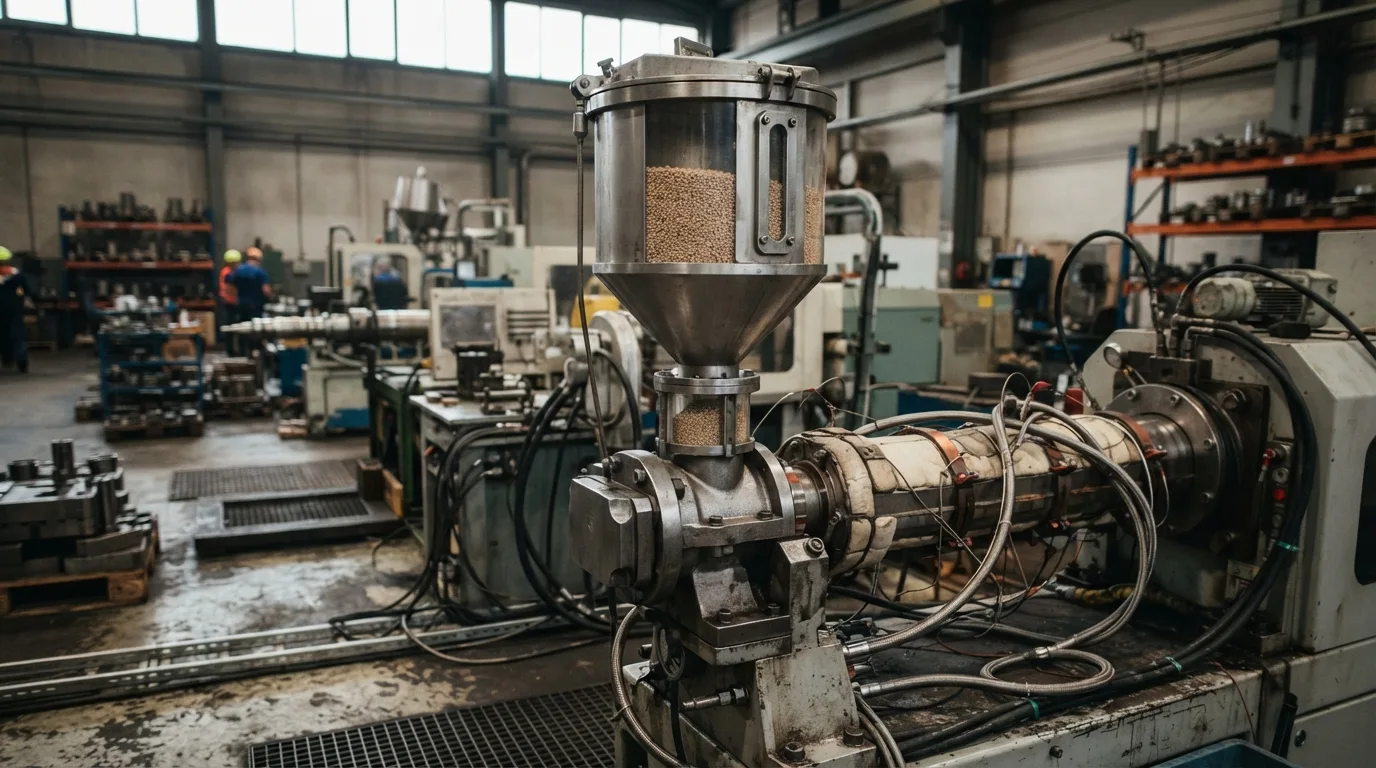 Factory hopper feeding uniform polymer pellets into an extruder
Inside the machine barrel, standard single-screw extruders feature length-to-diameter (L/D) ratios from 24:1 to 32:1, paired with screw compression ratios between 2.5:1 and 3.5:1. These screws rely on steady friction between pellet surfaces and the barrel wall to convey solids forward into the transition zone.
Uniform 2 to 4 mm beads compact predictably within the first four screw flights, venting entrained atmospheric air backward through the hopper. As mechanical compression increases, the packed solid bed melts evenly through conductive barrel heat and shear dissipation.
When sourcing plastic granules UAE converters evaluate bulk density and feed throat behaviour to prevent screw slip, back-pressure variation, and surging at the die head.
Virgin Resins vs Recycled Plastic Pellets: Technical Parameters to Check Before Sourcing
Recycled plastic pellets are made of sorted, washed post-industrial polyolefin streams that have been re-extruded, homogenised, and filtered into production-ready feedstocks. While freshly synthesized polymers display narrow property bands direct from chemical reactors, recycled grades require verification across several mechanical thresholds:
1. MFI Batch Consistency: Verify that the Melt Flow Index variation across delivered lots remains within a narrow relative variance of ±0.10 of the nominal target value. Broad MFI swings alter melt viscosity, forcing operators to adjust barrel temperatures, change injection pressures, or risk flash and short shots.
2. Moisture and Volatile Limits: Total moisture content must remain below 1000 ppm. Entrained water flashes into high-pressure steam within the 200 °C compression section, generating splay lines across injection-moulded surfaces, structural voids, and drool at extrusion dies.
3. Inorganic Ash Content: Ash content tests using ASTM D5630 track residual mineral fillers, talc, or non-polymeric contamination. Keep filler levels below 20 g/kg by weight unless processing a dedicated filled compound, as undispersed mineral grit reduces tensile elongation and notch impact resistance.
Rigorous compounding lines run these quality-control checks across production batches to verify melt homogeneity and prevent downtime during high-speed conversion. Technical support teams at Golden Square Plast supply verified datasheets for extrusion and moulding lines.
To review available polyolefin grades or arrange trial volumes for your facility, Request a quote.