
Published
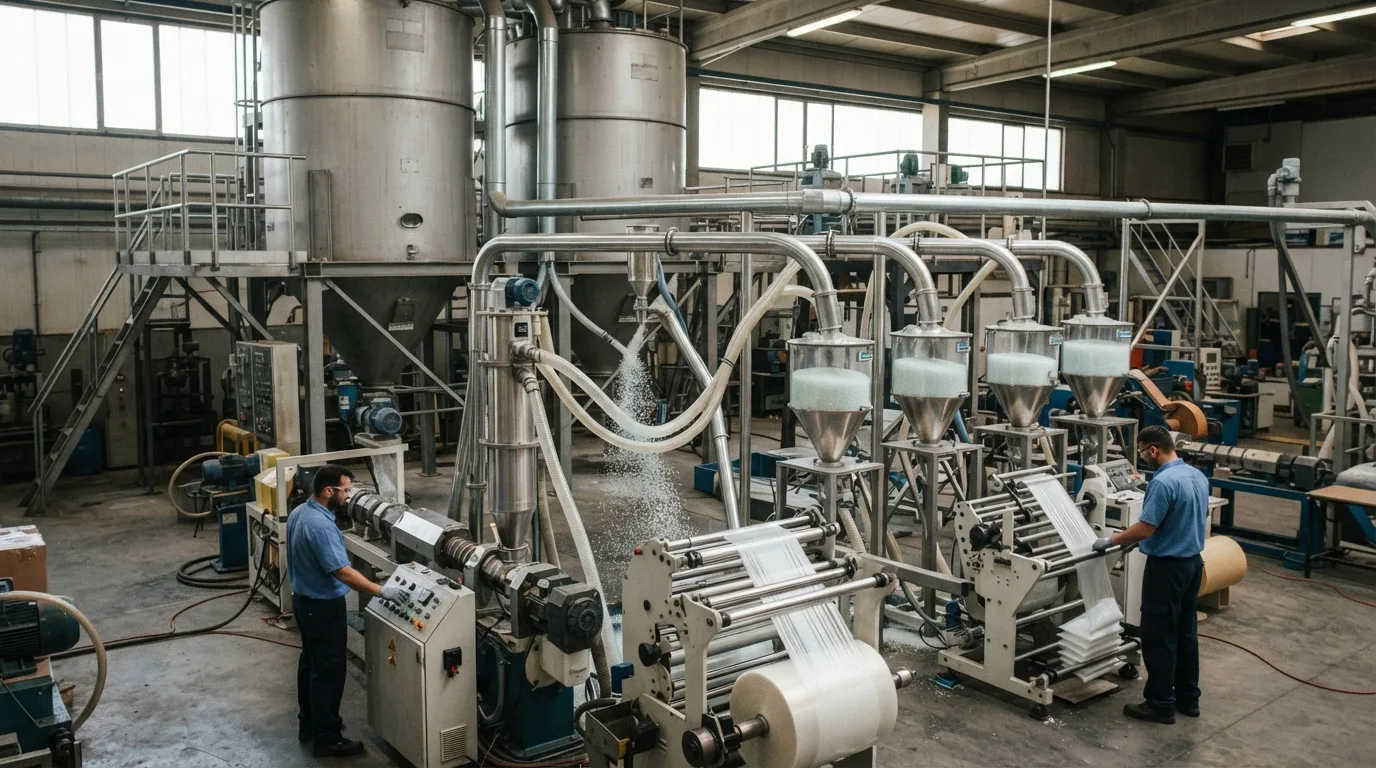 Polyethylene pellets used as raw material for plastic bags
The primary raw material for plastic bags is polyethylene resin derived from refined crude oil and natural gas feedstocks. Blown film lines process three main resin types: low-density polyethylene for bubble stability, linear low-density polyethylene for tear resistance, and high-density polyethylene for thin-gauge stiffness. Most bag converters blend these grades to balance bubble stability on the tower with mechanical bag strength.
Which Polymer Serves as the Raw Material for Plastic Bags?
The raw materials of plastic originate as petrochemical fossil feedstocks—principally crude oil and natural gas liquids—which refineries crack into olefin monomers like ethylene, making polyethylene the primary polymer commonly used to make plastic bags. The base plastic bag raw material divides into three primary density groups: Low-Density Polyethylene (LDPE), Linear Low-Density Polyethylene (LLDPE), and High-Density Polyethylene (HDPE).
Blown film extruders require narrow resin specifications to maintain a stable tubular bubble without melt fracture or gauge variation. The standard Melt Flow Index (MFI) target for film extruders ranges from 0.5 to 2.0 g/10 min when measured at 190°C under a 2.16 kg test mass. Resins outside this range disrupt film lines: an MFI below 0.5 g/10 min generates excessive barrel backpressure and melt overheating, while an MFI above 2.0 g/10 min lacks the melt viscosity needed to support the vertical bubble as it exits the die.
Density determines film stiffness and tear behavior:
- Low-Density and Linear Low-Density Resins: Range between 0.918 and 0.925 g/cm³. These grades produce supple, elastic films with high puncture resistance, making them ideal for merchandise packaging, grocery sacks, and heavy liners.
- High-Density Resins: Exceed 0.945 g/cm³. Dense molecular packing yields high tensile rigidity, allowing extruders to draw film down to thin gauges between 10 and 18 microns for lightweight checkout bags.
| Polymer Grade | MFI Range (g/10 min at 190°C, 2.16 kg) | Density (g/cm³) | Primary Bag Application | Key Extrusion Advantage |
|---|---|---|---|---|
| Film Grade LDPE | 0.75 – 2.0 | 0.919 – 0.923 | Retail shopping bags, shrink wrap | High melt strength, broad bubble stability |
| LLDPE Film (C4/C6) | 0.8 – 1.2 | 0.918 – 0.924 | Liners, agricultural sacks | High tensile yield, puncture resistance |
| HDPE Film | 0.05 – 0.12 (High load: 8–12) | 0.948 – 0.955 | T-shirt grocery sacks, thin bags | High tensile stiffness, thin draw-down |
| Reprocessed LDPE/LLDPE | 0.8 – 1.8 | 0.920 – 0.926 | Refuse liners, utility packaging | Balanced draw-down, operational economy |
| PBAT / PLA Compound | 1.5 – 3.5 | 1.22 – 1.26 | Organic waste bags, produce sacks | Compostable degradation profile |
Film Grade LDPE vs LLDPE: How Polymer Chains Dictate Bag Strength
The base raw materials for making plastic bags rely on differing molecular branch patterns to balance clarity against drop impact. Autoclave and tubular reactors produce film grade LDPE with long-chain branches that entangle during melt flow. This entanglement gives the molten tube high melt strength, holding the bubble steady against air ring turbulence. The branched structure delivers surface gloss and high clarity, but limits tensile strength and puncture performance.
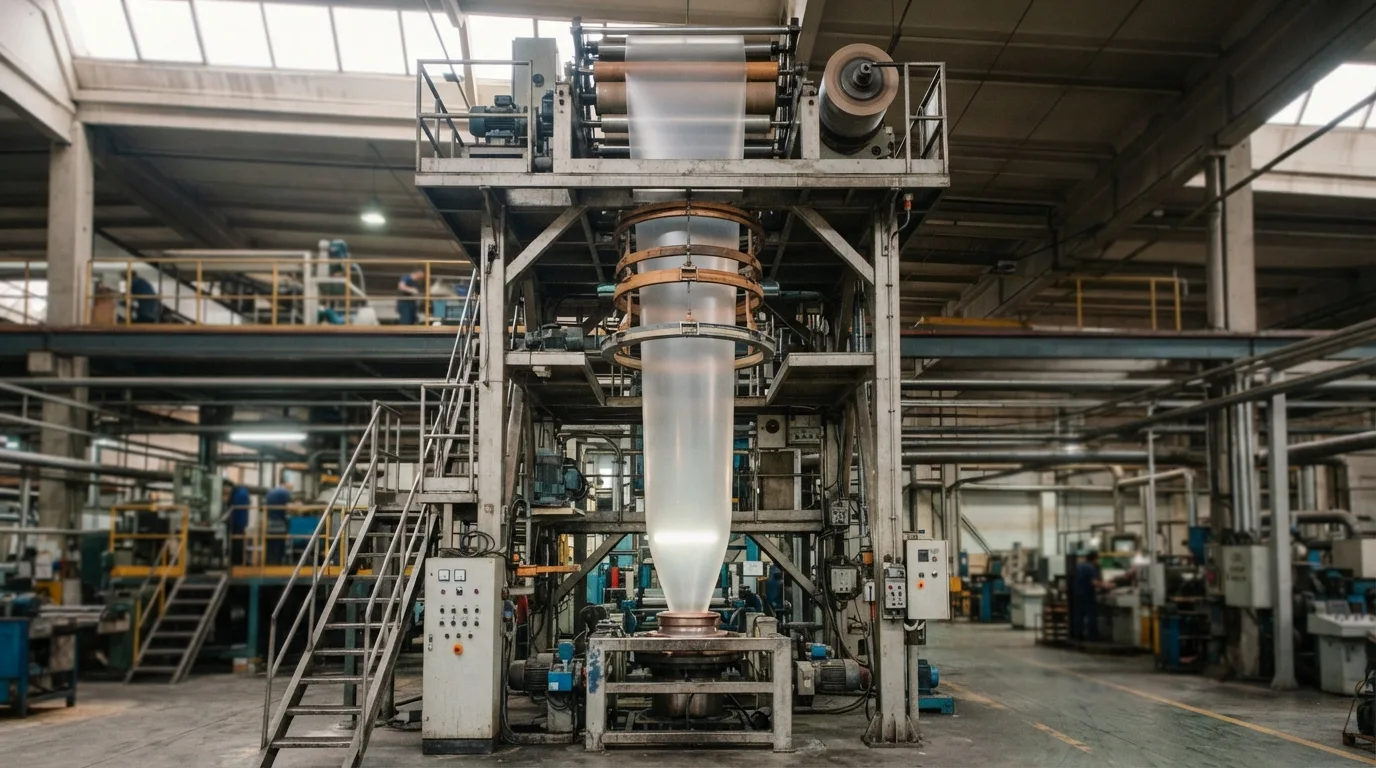 Extrusion bubble of blown film rising inside an industrial manufacturing facility
LLDPE consists of a linear polymer backbone with short, uniform branches created via coordination catalysis. When stressed, these linear molecules slide and align under load, distributing tensile energy across the film. LLDPE provides superior puncture resistance and tensile yield, but its narrow molecular weight distribution yields lower melt strength, causing bubble wobble when run unblended on conventional dies.
Film producers test different blend ratios to balance line stability and finished bag performance:
- Clarity Retail Sacks: A practical trial ratio of 70 parts LDPE with 30 parts LLDPE balances optical gloss with puncture resistance on standard blown film lines.
- Heavy Shipping Bags: Inverting the ratio to approximately 70 parts LLDPE and 30 parts LDPE serves as a typical trial formulation to maximize tear resistance while retaining enough melt strength to run at high haul-off speeds.
Dart drop tests demonstrate this mechanical contrast. At a 30-micron gauge, an unblended LDPE film yields dart drop impact values between 80 and 120 g before rupture. Reinforcing the melt with high-grade LLDPE or metallocene resin raises dart impact values beyond 250 g, preventing bag puncture from sharp container corners.
Garbage Bag Raw Material: Formulating Heavy-Duty and Utility Liners
Heavy utility sacks require tough raw materials for making plastic bags that maximize tear strength and seam yield at an economical material cost. A functional trial formulation for garbage bag raw material blends reprocessed LDPE and LLDPE granules with fractional-melt HDPE. Reprocessed LDPE/LLDPE supplies tear elongation and bottom-weld strength, while trial additions of 10 to 20 parts fractional-melt HDPE per 100 parts base resin increase the elastic modulus to prevent bag sagging when loaded.
Lines add black masterbatch at dosing rates of 1.5 to 3.0 parts per 100 parts resin to ensure full opacity and protect outdoor sacks against ultraviolet degradation. Masterbatch quality must feature fine pigment dispersion. Large pigment agglomerates create weak spots in the molten web, triggering bubble pinholes and split bottom seals.
Film gauges follow clear utility thresholds:
- Residential Liners: Gauges between 25 and 55 microns balance light-to-medium puncture resistance with low resin consumption.
- Industrial Refuse Sacks: Gauges between 60 and 100 microns or higher provide the puncture resistance needed for construction rubble, wet refuse, and metal scrap.
Film converters evaluate reprocessed feedstocks based on consistent melt filtration, verified batch melt index, and uniform bulk density to maintain stable bubble geometry on industrial blown film extruders.
Recycled Plastic Granules in Blown Film Lines: Screen Filtration and Moisture Thresholds
Reprocessed polyolefin pellets serve as a dependable raw material for plastic bags, giving converters proven raw materials for making plastic bags when clean sorting and melt filtration protect bubble stability. Blown film extruders run narrow die gaps between 0.8 and 1.5 mm. Solid contaminants or unmelted polymer particles lodge inside the die orifice, creating drag lines, bubble blowouts, and seal failures.
```
Incoming Granule Quality Thresholds for Blown Film Lines
├── Melt Filtration: 100 to 150 mesh extruder pack screen
├── Moisture Limit: Strictly below 500 ppm (0.05 parts per 100)
├── Ash / Filler: Maximum 2.0 parts per 100 parts resin
└── MFI Tolerance: Within ±0.2 g/10 min of target baseline
```
Granule suppliers must pass their recycled melt through 100 to 150 mesh screens during pelletizing. Fine filtration removes burnt specks, foreign debris, and gel particles. Line operators extruding reprocessed resin should also fit dual-screen hydraulic screen changers with a 100-mesh backing wire to protect the die lip.
Moisture control is equally critical. Blown film towers cannot tolerate moisture inside the extruder barrel. When damp granules enter the feed zone, barrel heat vaporizes the water into steam. This steam reaches the die head, causing bubble surging, vapor lensing, and pinholes that collapse the bubble. Granule moisture must remain below 500 ppm. Any resin exposed to ambient humidity must pass through a desiccant dryer before extrusion.
Reprocessed resin substitution ratios depend on the finished bag application:
- Heavy Refuse Sacks: Can run up to 100 parts reprocessed Recycled LDPE / LLDPE Granules Supplier in the UAE or Recycled HDPE Blow / Extrusion Grade — Film & Liners when film clarity is not a requirement.
- Carrier Bags: Run 20 to 40 parts reprocessed pellets blended with virgin LLDPE to preserve tensile yield and surface finish.
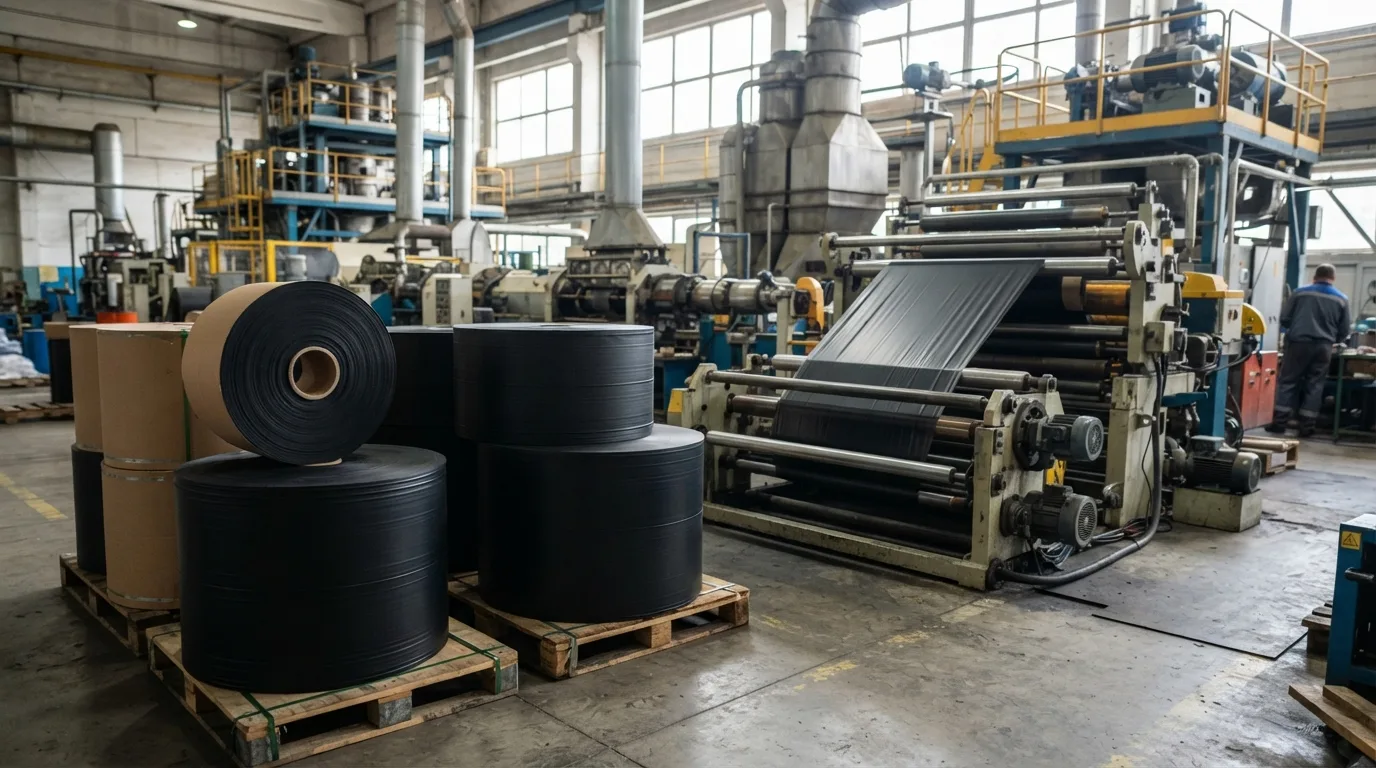 Rolls of heavy black utility bags manufactured from recycled polyethylene pellets
Biodegradable Polymers vs Conventional Film Resins: Processing Realities
The raw material for biodegradable plastic bags consists of compostable polyesters such as PBAT blended with PLA or starch, which do not shed persistent microplastics through environmental fragmentation like conventional polyethylene bags do under weathering. Plastic bags do not release microplastic particles during normal static handling or dry indoor storage. However, when discarded bags face outdoor sunlight and physical friction, solar ultraviolet exposure breaks polymer backbones apart, fragmenting the sheet into microplastic particles. Compostable formulations avoid this long-term fragmentation by decomposing into water and organic biomass under managed industrial composting.
Extruding compostable compounds requires strict processing boundaries:
- Narrow Thermal Window: PBAT/PLA compounds melt between 140°C and 160°C. Exceeding 175°C in the barrel degrades the polyester chains, causing loss of melt strength and bubble sag.
- Hydrolytic Sensitivity: Chemical linkages degrade when exposed to heat and moisture. Granules must be dried using desiccant air dryers to moisture levels below 200 ppm prior to feeding.
- Microplastics Distinction: Genuine compostable films undergo complete biological breakdown. Oxo-degradable additives, by contrast, merely accelerate the physical fragmentation of conventional polyethylene into fine microscopic dust that lingers in waterways and soil.
Misconceptions in Bag Raw Material Sourcing and What to Ask Granule Suppliers
Selecting the right raw material for plastic bags requires separating factory floor assumptions from polymer rheology.
One common misconception is that using resin with an MFI above 3.0 g/10 min increases line output. High-MFI resin flows easily through the barrel but lacks melt strength. Once extruded vertically, the molten bubble sags under its own weight, causing gauge variation around the bubble and weak bottom welds. Consistent blown film lines require an MFI between 0.8 and 1.8 g/10 min.
Another misconception is that dark or grey reprocessed pellets lack mechanical strength compared to translucent granules. Dark coloration usually comes from mixed printed film scrap. If the reprocessor washes the feedstock thoroughly and uses fine melt filtration, grey or black pellets deliver tensile and dart impact strength matching natural reprocessed grades.
Practical shop-floor evaluations protect film lines before committing large tonnage to silo storage:
- Hot-plate smear checks reveal physical contamination. Melt five to ten sample granules between two glass slides on a 200°C laboratory hot plate, press them thin, and hold the glass to a light source. This simple test exposes unmelted gels, paper lint, or dense mineral specks before hoppers are filled.
- Demand verified melt flow stability. Require the resin supplier to hold batch-to-batch MFI variance within plus or minus 0.2 g/10 min of data sheet values to prevent constant motor load swings and bubble instability.
- Monitor screen pack pressure curves. A rapid rise in hydraulic pressure exceeding 15 bar within two hours across a 120-mesh screen indicates excessive mineral filler, requiring ash analysis to confirm total filler stays below 2 parts per 100 parts resin.
- Gauge bulk density. Weigh a standard one-liter container of incoming pellets to confirm bulk density sits between 0.50 and 0.55 kg/L. Irregular granule sizing causes bridging and erratic feeding in gravity throat throats.
Safe plant operation requires dust extraction during material blending and localized exhaust ventilation above extruder dies to capture heating fumes. Recycled polyolefin granules are engineered strictly for non-food utility packaging, waste liners, construction films, and industrial refuse sacks.
To evaluate technical specifications for reprocessed film grades or arrange production trials with Golden Square Plast, Request a quote.